北京大学学报(医学版) ›› 2026, Vol. 58 ›› Issue (2): 388-392. doi: 10.19723/j.issn.1671-167X.2026.02.025

• 技术方法 • 上一篇    下一篇

胸主动脉腔内修复术左肱动脉穿刺点使用血管缝合器处理的临床效果

李伟浩, 张学民*(), 李伟, 张韬, 张小明   

  1. 北京大学人民医院血管外科,北京 100044
  • 收稿日期:2023-09-06 出版日期:2026-04-18 发布日期:2025-07-25
  • 通讯作者: 张学民
  • 基金资助:
    北京市西城区财政科技专项(XCSTS-SD2022-05)

Outcomes of suture-mediated vascular closure device in the closure of left brachial artery access site after thoracic endovascular aortic repair

Weihao LI, Xuemin ZHANG*(), Wei LI, Tao ZHANG, Xiaoming ZHANG   

  1. Department of Vascular Surgery, Peking University People's Hospital, Beijing 100044, China
  • Received:2023-09-06 Online:2026-04-18 Published:2025-07-25
  • Contact: Xuemin ZHANG
  • Supported by:
    the Beijing Xicheng District Science and Technology Special Projects(XCSTS-SD2022-05)

RICH HTML


摘要:

目的: 探讨胸主动脉腔内修复术(thoracic endovascular aortic repair,TEVAR)左肱动脉穿刺点使用血管缝合器处理的有效性和安全性。方法: 回顾分析北京大学人民医院2021年1月至2023年5月接受TEVAR并行左肱动脉穿刺置鞘的91例患者的临床资料,其中,肱动脉直径大于5 mm的患者27例,其左肱动脉穿刺点使用血管缝合器处理,另外64例患者的肱动脉直径小于5 mm,对其左肱动脉穿刺点行单纯压迫。对比两种穿刺点处理方法的围术期并发症以及长期结果。结果: 术后,血管缝合器组加压绷带的压迫时间显著减少(P<0.001),压迫相关的肢体麻木、疼痛、肿胀等不适症状的比例显著低于单纯压迫组(3.70% vs. 42.19%,P<0.001)。血管缝合组住院期间发生急性肱动脉闭塞1例,需行肱动脉切开修复;单纯压迫组住院期间发生肱动脉穿刺点并发症4例,其中单纯血肿3例,行保守治疗,假性动脉瘤1例,需再次手术。两组早期穿刺点相关并发症的发生率差异无统计学意义(3.70% vs. 6.25%,P=0.625)。所有患者平均随访(14±6)个月,两组患者均未发生左肱动脉穿刺点相关并发症。结论: TEVAR左肱动脉穿刺点采用血管缝合器处理是有效的,且长期效果满意,尤其适合用于血管直径大于5 mm的患者。

关键词: 血管闭合装置, 胸主动脉腔内修复术, 肱动脉, 治疗结果

Abstract:

Objective: To evaluate the feasibility and safety of the suture-mediated vascular closure device in the closure of the left brachial artery access site after thoracic endovascular aortic repair (TEVAR). Methods: Data from 91 patients receiving TEVAR with left brachial artery puncture from January 2021 to May 2023 were retrospectively collected and analyzed. In 27 cases whose brachial artery was over 5 mm, a suture-mediate vascular closure device (Perclose ProGlide, Abbott) was used to deal with the left brachial artery access, and in the other 64 cases with brachial artery < 5 mm, manual compression was used. The primary outcomes were the incidence of perioperative access-related complications and long-term outcomes. Results: In the suture-mediate device group, the access-site compression time was significantly reduced than that in the manual compression group (P < 0.001). The proportion of discomforts, such as numbness, pain, and swelling of the compression-related limbs was significantly lower than that in the compression-alone group (3.70% vs. 42.19%, P < 0.001). One case with brachial artery access-related complications occurred in the suture-mediate device group during hospitalization, which was acute brachial artery occlusion and required reinterventions. In the manual compression group, 4 cases of brachial artery puncture point complications occurred during hospitalization, including 3 cases of pure hematoma with conservative management and 1 case of pseudoaneurysm requiring reintervention. There was no significant difference in the incidence of early puncture point complications between the two groups (3.70% vs. 6.25%, P=0.625). During an average follow-up of (14±6) months, no access-related complications of the left brachial artery occurred. Conclusion: It is effective to use the suture-mediated vascular closure in the left brachial artery access site after TEVAR, and the long-term effect is satisfactory. For patients with >5 mm brachial artery, it is reasonable to use suture-mediated vascular devices to deal with brachial artery access.

Key words: Vascular closure device, Thoracic endovascular aortic repair, Brachial artery, Treatment outcome

中图分类号: 

  • R654.3

表1

两组患者间基本资料对比"

Items Suture-mediate device group (n=27) Compression-alone group (n=64) Statistic P
Gender (male) 22 (81.48) 53 (82.81) >0.999a
Age/years 47.3±13.6 54.2±13.2 -2.255 0.027
BMI/(kg/m2) 24.2±3.6 26.5±5.7 -1.071 0.287
Smoking history 12 (44.44) 30 (46.88) 0.045a 0.832
Hypertension 19 (70.37) 53 (82.81) 1.779a 0.182
Diabetes 2 (7.41) 5 (7.81) >0.999a
Coronary heart disease 2 (7.41) 8 (12.50) 0.732a
Peripheral arterial disease 0 (0) 3 (4.69) 0.552a
ASA grade 0.941a
  Ⅰ 1 (3.70) 5 (7.81)
  Ⅱ 13 (48.15) 26 (40.62)
  Ⅲ 11 (40.74) 27 (42.19)
  Ⅳ 2 (7.41) 6 (9.38)

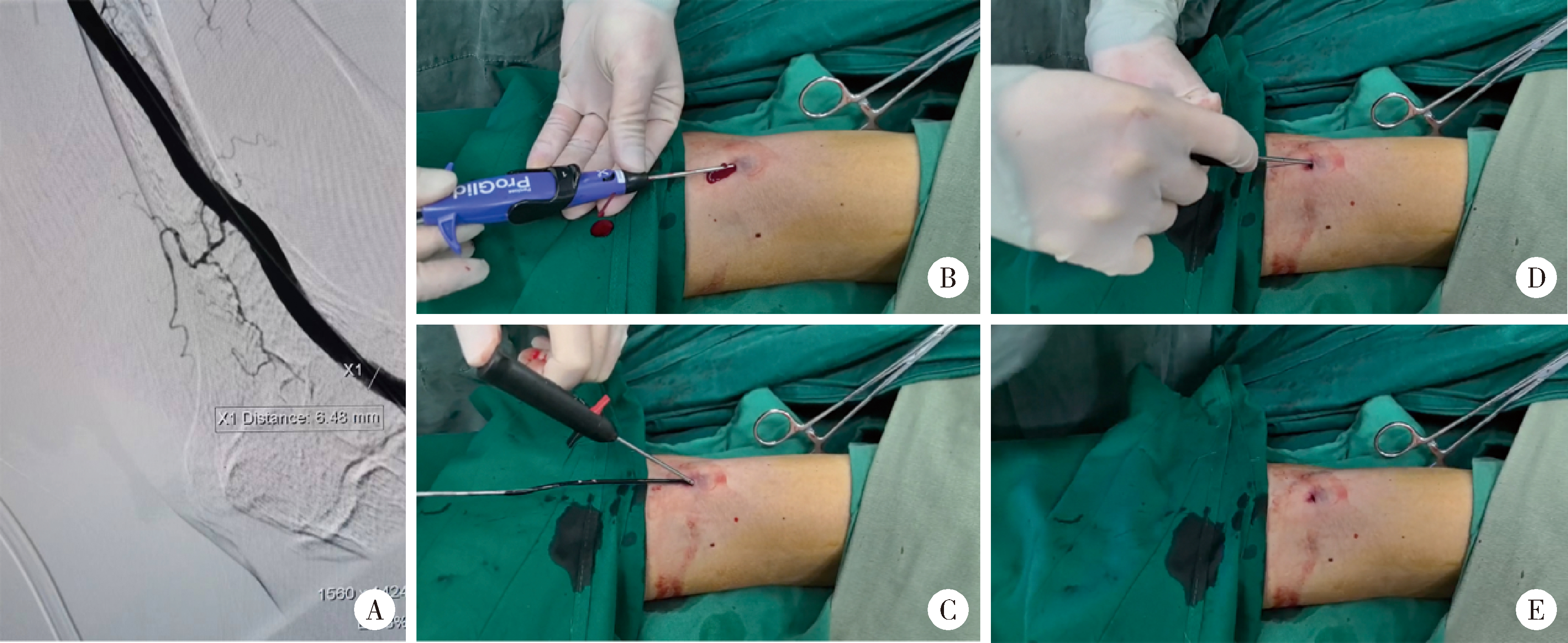
图1

使用血管缝合器的手术步骤"

表2

两组间肱动脉压迫结果的比较"

Items Suture-mediate device group (n=27) Compression-alone group (n=64) Statistic P
Brachial artery diameter/mm 5.4±0.3 4.2±0.4 14.7 <0.001
Vascular sheath 0.077a
  5F 0 (0) 5 (7.81)
  6F 19 (70.37) 52 (81.25)
  7F 6 (22.22) 7 (10.94)
  8F 2 (7.41) 0 (0)
Compression time/h 6 (6, 7) 22 (20, 25) -7.537b <0.001b
Oppression-related discomfort 1 (3.70) 27 (42.19) <0.001a
Puncture point complication 1 (3.70) 4 (6.25) 0.625a
  Thrombopoiesis 1 (3.70) 0 (0)
  Hematoma/pseudoaneurysm 0 (0) 4 (6.25)
1
Mandigers TJ , Lomazzi C , Domanin M , et al. Vascular access challenges in thoracic endovascular aortic repair: A literature review[J]. Ann Vasc Surg, 2023, 94, 22- 31.

doi: 10.1016/j.avsg.2022.10.001
2
Noori VJ , Eldrup-Jørgensen J . A systematic review of vascular closure devices for femoral artery puncture sites[J]. J Vasc Surg, 2018, 68 (3): 887- 899.

doi: 10.1016/j.jvs.2018.05.019
3
Dunn K , Jessula S , Herman CR , et al. Safety and effectiveness of single ProGlide vascular access in patients undergoing endovascular aneurysm repair[J]. J Vasc Surg, 2020, 72 (6): 1946- 1951.

doi: 10.1016/j.jvs.2020.03.028
4
孙占国, 蒋京军, 张小明, 等. TEVER术中主动脉弓部分支动脉的重建[J]. 中国普通外科杂志, 2014, 23 (12): 1609- 1613.
5
佟铸, 谷涌泉, 郭连瑞, 等. 肱动脉入路在腔内治疗中的应用及穿刺并发症分析[J]. 中国微创外科杂志, 2012, 12 (6): 547-549, 553.
6
王汝涛, 戴一, 刘毅, 等. 冠脉造影术中肱动脉穿刺的常见并发症及处理[J]. 临床医学研究与实践, 2017, 2 (32): 115-116, 123.
7
徐彦成, 刘祎秀. 肱动脉穿刺在经皮冠状动脉介入治疗术后并发症的预防及处理研究[J]. 中西医结合心血管病电子杂志, 2018, 6 (9): 82-83, 86.
8
史作霞, 张文彦, 李馨, 等. 改良桡动脉止血器在老年ACS患者动脉穿刺后压迫止血中的效果[J]. 医学信息, 2020, 33 (2): 184- 185.
9
刘玉龙, 李承志, 王晓白, 等. ExoSeal血管封堵器在肱动脉高位穿刺点止血中的临床应用[J]. 介入放射学杂志, 2020, 29 (6): 560- 563.
10
Meertens MM , de Haan MW , Schurink GWH , et al. A stopped pilot study of the ProGlide closure device after transbrachial endovascular interventions[J]. J Endovasc Ther, 2019, 26 (5): 727- 731.

doi: 10.1177/1526602819862775
[1] FarinEbrahimi, 冯志强, FarazEbrahimi, 韩玮华, 于子杨, 贾宽宽, 安金刚. 上颌药物相关性颌骨坏死的不同分期手术治疗效果[J]. 北京大学学报(医学版), 2026, 58(1): 107-114.
[2] 潘莲菲, 李文静, 王瑞洋, 焦剑, 曹战强, 高丽, 释栋. 口服抗生素辅助牙周机械治疗对重度牙周炎的短期疗效及影响因素[J]. 北京大学学报(医学版), 2026, 58(1): 30-36.
[3] 康一帆, 葛严军, 吕晓鸣, 谢尚, 单小峰, 蔡志刚. 即刻种植体支持式义齿修复的血管化髂骨瓣重建下颌骨缺损[J]. 北京大学学报(医学版), 2025, 57(1): 78-84.
[4] 李文菁,张保宙,李恒,赖良鹏,杜辉,孙宁,龚晓峰,李莹,王岩,武勇. 胫距跟融合治疗终末期踝和后足病变的中短期临床结果[J]. 北京大学学报(医学版), 2024, 56(2): 299-306.
[5] 邹雪,白小娟,张丽卿. 艾拉莫德联合托法替布治疗难治性中重度类风湿关节炎的疗效[J]. 北京大学学报(医学版), 2023, 55(6): 1013-1021.
[6] 薛蔚,董樑,钱宏阳,费笑晨. 前列腺癌新辅助治疗与辅助治疗的现状及进展[J]. 北京大学学报(医学版), 2023, 55(5): 775-780.
[7] 邱敏,宗有龙,王滨帅,杨斌,徐楚潇,孙争辉,陆敏,赵磊,卢剑,刘承,田晓军,马潞林. 腹腔镜肾部分切除术治疗中高复杂程度肾肿瘤的效果[J]. 北京大学学报(医学版), 2023, 55(5): 833-837.
[8] 王磊,韩天栋,江卫星,李钧,张道新,田野. 主动迁移技术与原位碎石技术在输尿管软镜治疗1~2 cm输尿管上段结石中的安全性和有效性比较[J]. 北京大学学报(医学版), 2023, 55(3): 553-557.
[9] 李伟浩,李伟,张学民,李清乐,焦洋,张韬,蒋京军,张小明. 去分支杂交手术和传统手术治疗胸腹主动脉瘤的结果比较[J]. 北京大学学报(医学版), 2022, 54(1): 177-181.
[10] 朱正达,高岩,何汶秀,方鑫,刘洋,魏攀,闫志敏,华红. 红色诺卡氏菌细胞壁骨架治疗糜烂型口腔扁平苔藓的疗效及安全性[J]. 北京大学学报(医学版), 2021, 53(5): 964-969.
[11] 李潇,苏家增,张严妍,张丽琪,张亚琼,柳登高,俞光岩. 131I相关唾液腺炎的炎症分级及内镜治疗[J]. 北京大学学报(医学版), 2020, 52(3): 586-590.
[12] 詹颖,杜祎甜,仰浈臻,张春丽,齐宪荣. 紫杉醇微球-原位凝胶的制备及其局部注射的抗肿瘤药效[J]. 北京大学学报(医学版), 2019, 51(3): 477-486.
[13] 杨泽川,刘朝旭,林阳,胡伟华,陈文坚,李锋,曾恒. 颈后路单开门椎管扩大成形术全钛板与交替钛板、缝线固定治疗颈椎病的对比研究[J]. 北京大学学报(医学版), 2019, 51(1): 187-193.
[14] 游文喆,窦桂丽,夏斌. 乳牙间接牙髓治疗两年疗效观察及影响因素分析[J]. 北京大学学报(医学版), 2019, 51(1): 65-69.
[15] 李欣艺,赵金霞,刘湘源. 抗磷脂抗体相关性复发性流产的诊治:附75例抗磷脂综合征患者妊娠期用药和结局分析[J]. 北京大学学报(医学版), 2018, 50(6): 956-961.
Viewed
Full text


Abstract

Cited

  Shared   
  Discussed   
No Suggested Reading articles found!