北京大学学报(医学版) ›› 2026, Vol. 58 ›› Issue (2): 285-289. doi: 10.19723/j.issn.1671-167X.2026.02.010

• 工作综述 • 上一篇    下一篇

干细胞功能调控在颅颌面组织再生修复中的研究进展

张晗*, 杨馥嘉*, 杨瑞莉*()   

  1. 北京大学口腔医学院·口腔医院正畸科, 国家口腔医学中心, 国家口腔疾病临床医学研究中心, 口腔生物材料和数字诊疗装备国家工程研究中心, 口腔数字医学北京市重点实验室, 北京 100081
  • 收稿日期:2025-09-09 出版日期:2026-04-18 发布日期:2026-03-12
  • 通讯作者: 杨瑞莉
  • 作者简介:

    * These authors contributed equally to this work

  • 基金资助:
    国家重点研发计划(2022YFA1105800); 国家自然科学基金(U2330102); 北京市自然科学基金(7232219)

Progress in regulating stem cell functions for repair and regeneration of craniomaxillofacial tissues

Han ZHANG, Fujia YANG, Ruili YANG*()   

  1. Department of Orthodontics, Peking University School and Hospital of Stomatology & National Center for Stomatology & National Clinical Research Center for Oral Diseases & National Engineering Research Center of Oral Biomaterials and Digi-tal Medical Devices & Beijing Key Laboratory of Digital Stomatology, Beijing 100181, China
  • Received:2025-09-09 Online:2026-04-18 Published:2026-03-12
  • Contact: Ruili YANG
  • Supported by:
    the National Key Research and Development Program of China(2022YFA1105800); the National Natural Science Foundation of China(U2330102); the Beijing Natural Science Foundation(7232219)

RICH HTML


摘要:

颅颌面组织再生修复是口腔与再生医学领域的关键挑战。间充质基质/干细胞(mesenchymal stromal/stem cells, MSCs)作为核心效应细胞, 其功能受代谢、表观遗传与免疫网络的多维精密调控。本文系统综述了MSCs在颅颌面组织再生中的功能调控机制, 重点探讨了力学刺激、代谢重编程、H2S气体信号以及表观遗传修饰对MSCs干性维持、定向分化及免疫调节功能的影响。同时, 阐述了MSCs通过外泌体等载体与免疫细胞相互作用, 共同调控骨稳态与再生进程的双向机制。文末展望了基于MSCs及其工程化外泌体的靶向治疗策略所面临的挑战与临床转化前景, 旨在为颅颌面缺损的再生修复提供新的见解。

关键词: 间充质干细胞, 再生, 组织工程, 颅骨, 面骨

Abstract:

Craniofacial tissue regeneration remains a pivotal challenge in oral and regenerative medicine. Mesenchymal stem/stromal cells (MSCs) are central effector cells in this process, and their functions are regulated by a sophisticated, multidimensional network. This article provides a comprehensive overview of the regulatory mechanisms governing MSCs in craniofacial regeneration. We highlight the interactive roles of metabolism, epigenetics, and immunity in precisely controlling MSC stemness, lineage-specific differentiation, and immunomodulatory capabilities. Key regulatory dimensions are explored in detail. Metabolic reprogramming, such as serine one-carbon metabolism and mitochondrial dynamics under hyperosmotic stress, couples energy production with epigenetic modifications to dictate MSC fate. The gasotransmitter hydrogen sulfide (H2S) exerts tissue-specific effects, modulating immunoregulation via the Fas/FasL axis in gingival MSCs and promoting odontogenic differentiation in dental pulp stem cells (DPSCs) via the transient receptor potential action channel subfamily vanilloid member 1 (TRPV1)/β-catenin pathway. Epigenetic mechanisms, including DNA demethylation by ten-eleven translocation (TET) enzymes and chromatin remodeling by special AT-rich sequence-binding protein 2 (SATB2), finely tune MSC homeostasis and differentiation potential. Crucially, MSCs do not function in isolation. Their bidirectional crosstalk with immune cells, mediated by exosomes and soluble factors, is essential for bone homeostasis. Mechanical overloading can trigger MSCs to promote T helper 17 (Th17) cell polarization via metabolic reprogramming, exacerbating bone destruction. Conversely, H2S-modified exosomes from M2 macrophages can enhance MSC osteogenesis, demonstrating a synergistic metabolic-immune axis for bone regeneration. Exosomes themselves serve as versatile therapeutic carriers, capable of delivering miRNAs (e.g., miR-125a/b) or functional mitochondrial DNA to modulate immunity or repair cellular metabolism. The clinical translation of MSCs holds great promise for treating conditions like periodontitis and temporomandibular joint disorders. Advances in engineered exosomes and biomaterial carriers (e.g., hydrogels) offer strategies for targeted delivery and enhanced efficacy. Future research must focus on developing tissue-specific delivery systems, refining exosome engineering for precise cargo loading, and leveraging multi-omics technologies to decipher the complex stem cell niche. This progression from empi-rical application to rationally designed, precision therapies will be critical for addressing clinical challenges in craniofacial reconstruction.

Key words: Mesenchymal stem cells, Regeneration, Tissue engineering, Skull, Facial bones

中图分类号: 

  • R782

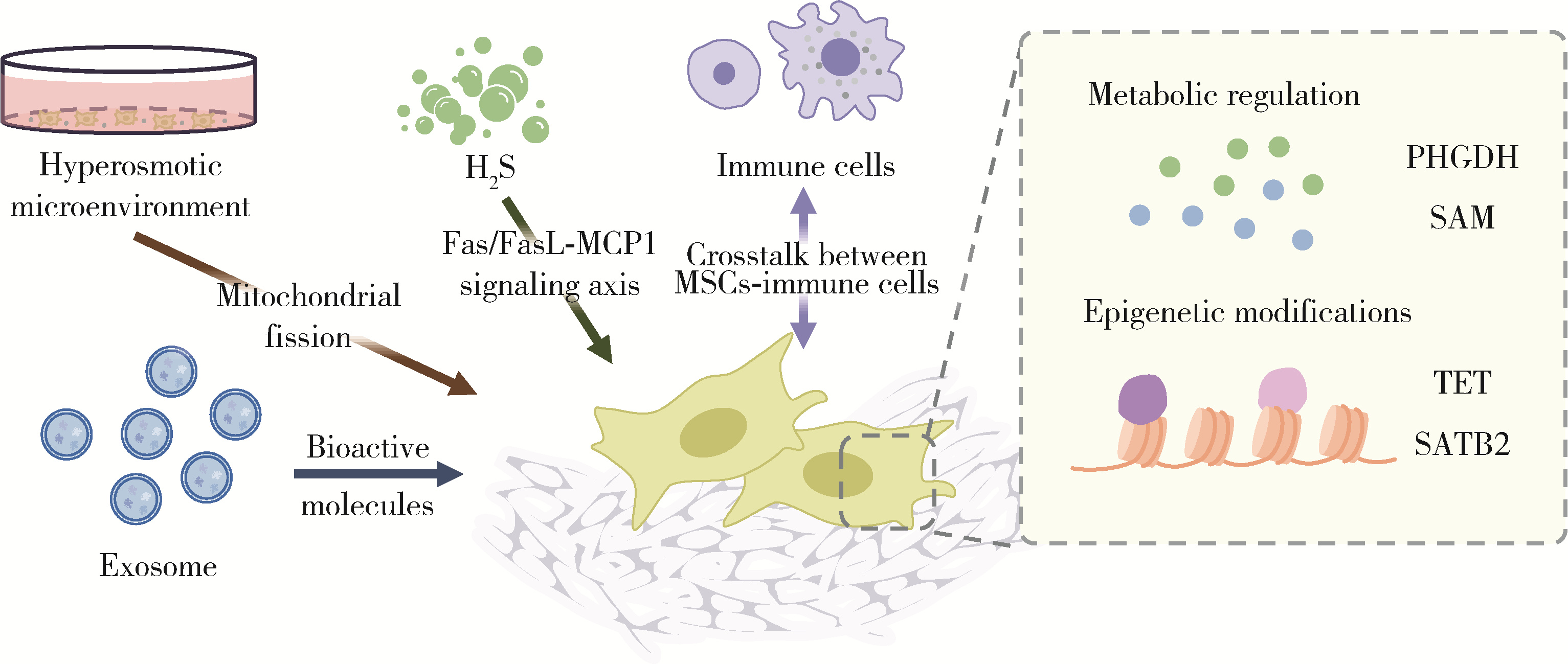
图1

干细胞功能调控示意图 MCP1, monocyte chemoattractant protein-1; MSCs, mesenchymal stromal/stem cells; PHGDH, phosphoglycerate dehydrogenase; SAM, S-adenosyl-methionine; TET, ten-eleven translocation; SATB2, special AT-rich sequence-binding protein 2."

1
Zhang H , Liu D , Wu T , et al. Exploring mesenchymal stem cell niches for regeneration[J]. Sci Bull, 2025, 70 (9): 1389- 1393.

doi: 10.1016/j.scib.2025.03.011
2
Xin T , Zhang T , Li Q , et al. A novel mutation of MSX1 in oligo-dontia inhibits odontogenesis of dental pulp stem cells via the ERK pathway[J]. Stem Cell Res Ther, 2018, 9 (1): 221.

doi: 10.1186/s13287-018-0965-3
3
Huang HM , Han CS , Cui SJ , et al. Mechanical force-promoted osteoclastic differentiation via periodontal ligament stem cell exosomal protein ANXA3[J]. Stem Cell Reports, 2022, 17 (8): 1842- 1858.

doi: 10.1016/j.stemcr.2022.06.006
4
Yang R , Yu T , Liu D , et al. Hydrogen sulfide promotes immunomodulation of gingiva-derived mesenchymal stem cells via the Fas/FasL coupling pathway[J]. Stem Cell Res Ther, 2018, 9 (1): 62.

doi: 10.1186/s13287-018-0804-6
5
Yang RL , Huang HM , Han CS , et al. Serine metabolism controls dental pulp stem cell aging by regulating the DNA methylation of p16[J]. J Dent Res, 2021, 100 (1): 90- 97.

doi: 10.1177/0022034520958374
6
Wang YM , Lin S , Chen LJ , et al. Mitochondrial components transferred by MSC-derived exosomes promoted bone regeneration under high salt microenvironment via DRP1/Wnt signaling[J]. Nano Res, 2024, 17 (9): 8301- 8315.

doi: 10.1007/s12274-024-6758-3
7
Yang R , Liu Y , Yu T , et al. Hydrogen sulfide maintains dental pulp stem cell function via TRPV1-mediated calcium influx[J]. Cell Death Discov, 2018, 4, 69.

doi: 10.1038/s41420-018-0071-4
8
Yang R , Yu T , Kou X , et al. Tet1 and Tet2 maintain mesenchymal stem cell homeostasis via demethylation of the P2rX7 promoter[J]. Nat Commun, 2018, 9 (1): 2143.

doi: 10.1038/s41467-018-04464-6
9
Yu T , Liu D , Zhang T , et al. Inhibition of Tet1- and Tet2-mediated DNA demethylation promotes immunomodulation of periodontal ligament stem cells[J]. Cell Death Dis, 2019, 10 (10): 780.

doi: 10.1038/s41419-019-2025-z
10
Xin T , Li Q , Bai R , et al. A novel mutation of SATB2 inhibits odontogenesis of human dental pulp stem cells through Wnt/β-catenin signaling pathway[J]. Stem Cell Res Ther, 2021, 12 (1): 595.

doi: 10.1186/s13287-021-02660-8
11
Zhou Y , Li M , Lin S , et al. Mechanical sensing protein PIEZO1 controls osteoarthritis via glycolysis mediated mesenchymal stem cells-Th17 cells crosstalk[J]. Cell Death Dis, 2025, 16 (1): 231.

doi: 10.1038/s41419-025-07577-1
12
Zhou YK , Han CS , Zhu ZL , et al. M2 exosomes modified by hydrogen sulfide promoted bone regeneration by moesin mediated endocytosis[J]. Bioact Mater, 2023, 31, 192- 205.
13
Yang R , Huang H , Cui S , et al. IFN-γ promoted exosomes from mesenchymal stem cells to attenuate colitis via miR-125a and miR-125b[J]. Cell Death Dis, 2020, 11 (7): 603.

doi: 10.1038/s41419-020-02788-0
14
Cui SJ , Zhang T , Fu Y , et al. DPSCs attenuate experimental progressive TMJ arthritis by inhibiting the STAT1 pathway[J]. J Dent Res, 2020, 99 (4): 446- 455.

doi: 10.1177/0022034520901710
15
Wei FL , Zhai Y , Wang TF , et al. Stem cell-homing biomimetic hydrogel promotes the repair of osteoporotic bone defects through osteogenic and angiogenic coupling[J]. Sci Adv, 2024, 10 (44): eadq6700.

doi: 10.1126/sciadv.adq6700
16
Chen P , Zhou YK , Han CS , et al. Stem cells from human exfoliated deciduous teeth alleviate liver cirrhosis via inhibition of gasdermin D-executed hepatocyte pyroptosis[J]. Front Immunol, 2022, 13, 860225.

doi: 10.3389/fimmu.2022.860225
[1] 李峥, 吕珑薇, 张晓, 夏丹丹, 张萍, 刘云松, 周永胜. 基于干细胞和生物材料调控的口腔颅颌面骨再生的研究进展[J]. 北京大学学报(医学版), 2026, 58(2): 272-277.
[2] 王昕莹, 程雪原, 张孟钧, 李菲, 段晋瑜, 乔静. 浓缩生长因子联合引导性组织再生术治疗下颌磨牙根分叉病变的疗效[J]. 北京大学学报(医学版), 2026, 58(2): 372-379.
[3] 曾立婷, 程凯远, 刘中宁, 李健, 杨静文, 姜婷. miR-488-5p促进大鼠骨髓间充质干细胞成神经、成骨分化及神经化骨再生[J]. 北京大学学报(医学版), 2026, 58(1): 10-21.
[4] 欧乾民, 李政诗, 牛露菡, 任倩慧, 刘欣雨, 毛学理, 施松涛. 口腔干细胞的生物学特性与转化研究[J]. 北京大学学报(医学版), 2025, 57(5): 827-835.
[5] 王宇蓝, 曾浩, 张玉峰. 口腔种植中血浆基质的临床转化现状与前沿探索[J]. 北京大学学报(医学版), 2025, 57(5): 836-840.
[6] 马保金, 李建华, 桑元华, 于洋, 仇吉川, 邵金龙, 李凯, 刘世岳, 杜密, 商玲玲, 葛少华. 基于微环境和干细胞调控的牙周组织再生关键技术的建立与应用[J]. 北京大学学报(医学版), 2025, 57(5): 841-846.
[7] 盛春辉, 张晓, 吕珑薇, 周永胜. 人脂肪间充质干细胞外泌体对去势小鼠骨质疏松的预防[J]. 北京大学学报(医学版), 2025, 57(2): 217-226.
[8] 李梦迪, 雷蕾, 刘中宁, 李健, 姜婷. siRNA沉默NLK基因促进神经化组织工程骨再生[J]. 北京大学学报(医学版), 2025, 57(2): 227-236.
[9] 王昕莹, 程雪原, 张勇, 李菲, 段晋瑜, 乔静. 浓缩生长因子与自固化磷酸钙人工骨联合治疗牙周骨下袋缺损的疗效:临床和影像学评价[J]. 北京大学学报(医学版), 2025, 57(1): 42-50.
[10] 帅婷, 郭艳艳, 林春平, 侯晓玫, 金婵媛. 敲减NPTX1促进人骨髓间充质干细胞成骨分化[J]. 北京大学学报(医学版), 2025, 57(1): 7-12.
[11] 武志慧, 胡明智, 赵巧英, 吕凤凤, 张晶莹, 张伟, 王永福, 孙晓林, 王慧. miR-125b-5p修饰脐带间充质干细胞对系统性红斑狼疮的免疫调控机制[J]. 北京大学学报(医学版), 2024, 56(5): 860-867.
[12] 陈晓颖,张一,李雨柯,唐琳,刘玉华. 不同种类聚合物对猪小肠黏膜下层支架仿生矿化的影响[J]. 北京大学学报(医学版), 2024, 56(1): 17-24.
[13] 赵菡,卫彦,张学慧,杨小平,蔡晴,宁成云,徐明明,刘雯雯,黄颖,何颖,郭亚茹,江圣杰,白云洋,吴宇佳,郭雨思,郑晓娜,李文静,邓旭亮. 口腔硬组织修复材料仿生设计制备和临床转化[J]. 北京大学学报(医学版), 2024, 56(1): 4-8.
[14] 潘媛,顾航,肖涵,赵笠君,汤祎熳,葛雯姝. 泛素特异性蛋白酶42调节人脂肪干细胞成骨向分化[J]. 北京大学学报(医学版), 2024, 56(1): 9-16.
[15] 刘晓强,周寅. 牙种植同期植骨术围术期高血压的相关危险因素[J]. 北京大学学报(医学版), 2024, 56(1): 93-98.
Viewed
Full text


Abstract

Cited

  Shared   
  Discussed   
No Suggested Reading articles found!