北京大学学报(医学版) ›› 2022, Vol. 54 ›› Issue (6): 1079-1085. doi: 10.19723/j.issn.1671-167X.2022.06.004
类风湿关节炎合并下肢静脉血栓患者的临床特点
刘蕊1,赵金霞1,*( ),闫良1,2
- 1. 北京大学第三医院风湿免疫科,北京 100191
2. 北京大学第三医院延安分院(延安市中医医院)急诊科,陕西延安 716000
Clinical characteristics of patients with rheumatoid arthritis complicated with venous thrombosis of lower extremities
Rui LIU1,Jin-xia ZHAO1,*(),Liang YAN1,2
- 1. Department of Rheumatology and Immunology, Peking University Third Hospital, Beijing 100191, China
2. Department of Emergency, Yan'an Branch of Peking University Third Hospital (Traditional Chinese Medicine Hospital of Yan'an), Yan'an 716000, Shaanxi, China
摘要:
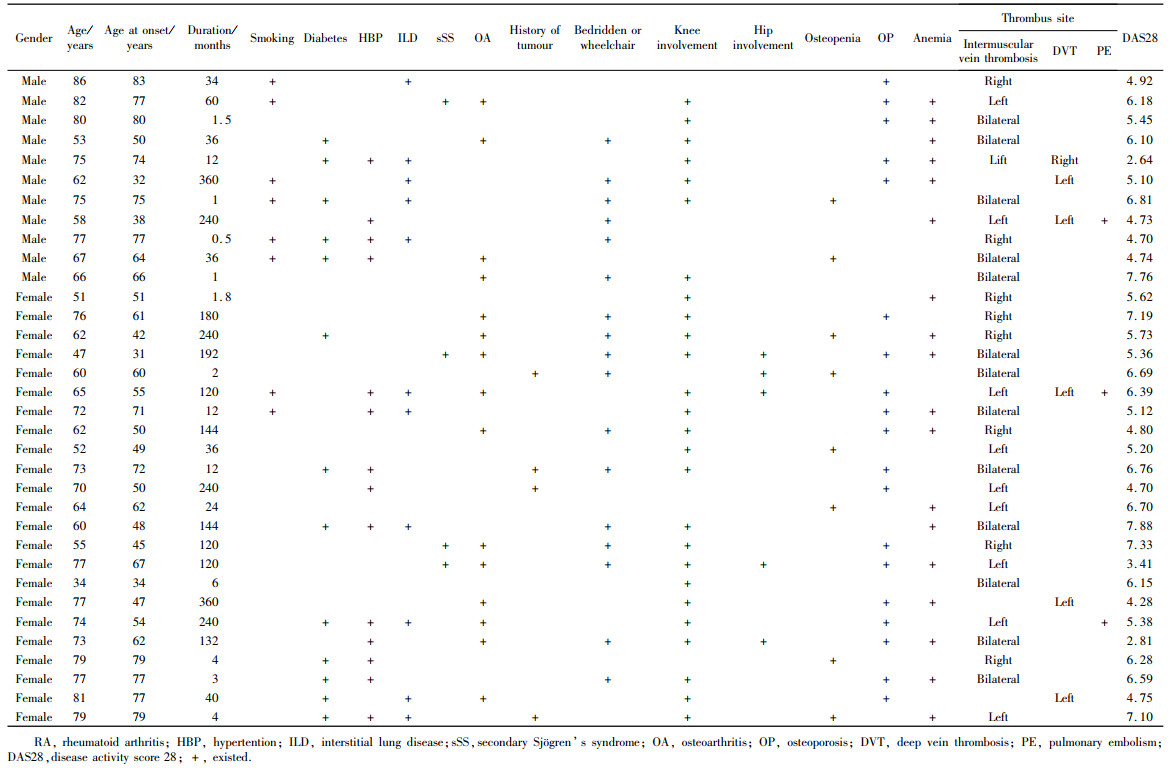
目的: 分析类风湿关节炎(rheumatoid arthritis,RA)合并下肢静脉血栓患者的临床特点,提高对该病的认识。方法: 选择自2013年11月1日至2020年12月31日期间在北京大学第三医院风湿免疫科住院的RA患者502例,回顾性分析入院诊断无下肢静脉血栓,出院诊断包含下肢静脉血栓的RA患者的临床和实验室检查指标特点,并将该组患者定义为血栓组,其他不合并下肢静脉血栓的患者作为对照组,进行两组间单因素分析,并对差异有统计学意义的因素进行多因素Logistic回归分析。结果: 血栓组患者34例(6.77%),对照组468例(93.23%)。血栓组年龄34~86岁(中位年龄71岁),女性23例,男性11例;单侧下肢静脉血栓20例(58.8%),双侧下肢静脉血栓14例(41.2%),其中3例(8.8%)合并肺栓塞(低危)。血栓组中17例(50.0%)患者入院前卧床大于1周或需要借助拐杖/轮椅活动,29例(85.3%)患者存在下肢大关节受累,髋关节、膝关节、踝关节以及膝、髋关节同时受累的患者分别为1、22、2和4例。血栓组28个关节疾病活动度评分(disease activity scores 28,DAS28)处于高、中、低疾病活动的患者分别为23例(67.6%)、9例(26.5%)和2例(5.9%)。有21例血栓组患者完善了易栓症相关检查,1例抗心磷脂抗体阳性,2例狼疮抗凝物阳性,1例抗β2-糖蛋白1抗体阳性,其余均为阴性。血栓组患者年龄[71(60, 77)岁vs. 60 (51, 68)岁,Z =-3.873, P<0. 01)]和血小板(platelet, PLT)水平[(328.53×10⁹±119.06×10⁹) /L vs.(278.68×10⁹±104.50×10⁹)/L, t =2.660, P<0.01] 均显著高于对照组,血栓组D-二聚体升高(94.1% vs.66.4%, χ2=11.192,P<0.01)以及类风湿因子(rheumatoid factor, RF)阳性(85.3% vs.67.1%,χ2 =4.852,P<0.05)的比例均显著高于对照组。Logistic回归分析发现RA发生下肢静脉血栓的危险因素包括年龄(OR =1.063, 95%CI: 1.026 ~ 1.101, P =0.001)、D-二聚体升高(OR =4.968, 95%CI: 1.136 ~ 21.730,P =0.033)和PLT水平(OR =1.004, 95%CI: 1.001 ~ 1.007, P =0.022)。结论: RA患者具有潜在下肢静脉血栓的风险,对于年龄大、D-二聚体和PLT升高,尤其是长时间卧床制动、高疾病活动度的RF阳性患者,需高度警惕下肢静脉血栓的风险。
中图分类号:
- R593.2

| 1 |
Li LY , Lu N , Avina-Galindo AM , et al. The risk and trend of pulmonary embolism and deep vein thrombosis in rheumatoid arthritis: A general population-based study[J]. Rheumatology (Oxford), 2021, 60 (1): 188- 195.
doi: 10.1093/rheumatology/keaa262 |
| 2 |
Matta F , Singala R , Yaekoub AY , et al. Risk of venous thromboembolism with rheumatoid arthritis[J]. Thromb Haemost, 2009, 101 (1): 134- 138.
doi: 10.1160/TH08-08-0551 |
| 3 |
Arnett FC , Edworthy SM , Bloch DA , et al. The American Rheumatism Association 1987 revised criteria for the classification of rheumatoid arthritis[J]. Arthritis Rheum, 1988, 31 (3): 315- 324.
doi: 10.1002/art.1780310302 |
| 4 |
Britsemmer K , Ursum J , Gerritsen M , et al. Validation of the 2010 ACR/EULAR classification criteria for rheumatoid arthritis: Slight improvement over the 1987 ACR criteria[J]. Ann Rheum Dis, 2011, 70 (8): 1468- 1470.
doi: 10.1136/ard.2010.148619 |
| 5 |
Chopard R , Albertsen IE , Piazza G . Diagnosis and treatment of lower extremity venous thromboembolism: A review[J]. JAMA, 2020, 324 (17): 1765- 1776.
doi: 10.1001/jama.2020.17272 |
| 6 |
Arshad N , Isaksen T , Hansen JB , et al. Time trends in incidence rates of venous thromboembolism in a large cohort recruited from the general population[J]. Eur J Epidemiol, 2017, 32 (4): 299- 305.
doi: 10.1007/s10654-017-0238-y |
| 7 |
Meng K , Hu X , Peng X , et al. Incidence of venous thromboembolism during pregnancy and the puerperium: A systematic review and meta-analysis[J]. J Matern Fetal Neonatal Med, 2015, 28 (3): 245- 253.
doi: 10.3109/14767058.2014.913130 |
| 8 | Croles FN , Nasserinejad K , Duvekot JJ , et al. Pregnancy, thrombophilia, and the risk of a first venous thrombosis: systematic review and Bayesian meta-analysis[J]. BMJ, 2017, 359, j4452. |
| 9 | Crous-Bou M , de Vivo I , Camargo CA Jr. , et al. Interactions of established risk factors and a GWAS-based genetic risk score on the risk of venous thromboembolism[J]. Thromb Haemost, 2016, 116 (4): 705- 713. |
| 10 | Heit JA , Ashrani A , Crusan DJ , et al. Reasons for the persistent incidence of venous thromboembolism[J]. ThrombHaemost, 2017, 117 (2): 390- 400. |
| 11 |
Mean M , Limacher A , Stalder O , et al. Do factor V Leiden and prothrombin G20210A mutations predict recurrent venous thromboembolism in older patients?[J]. Am J Med, 2017, 130 (10): 1220.e17- 1220.e22.
doi: 10.1016/j.amjmed.2017.05.026 |
| 12 |
Gregson J , Kaptoge S , Bolton T , et al. Cardiovascular risk factors associated with venous thromboembolism[J]. JAMA Cardiol, 2019, 4 (2): 163- 173.
doi: 10.1001/jamacardio.2018.4537 |
| 13 |
Peng YH , Lin YS , Chen CH , et al. Type 1 diabetes is associated with an increased risk of venous thromboembolism: A retrospective population-based cohort study[J]. PLoS One, 2020, 15 (1): e0226997.
doi: 10.1371/journal.pone.0226997 |
| 14 |
Riva N , Donadini MP , AgenoW . Epidemiology and pathophysiology of venous thromboembolism: Similarities with atherothrombosis and the role of inflammation[J]. Thromb Haemost, 2015, 113 (6): 1176- 1183.
doi: 10.1160/TH14-06-0563 |
| 15 |
Chen CY , Liao KM . The incidence of deep vein thrombosis in Asian patients with chronic obstructive pulmonary disease[J]. Medicine (Baltimore), 2015, 94 (44): e1741.
doi: 10.1097/MD.0000000000001741 |
| 16 |
Ogdie A , McGill NK , Shin DB , et al. Risk of venous thromboembolism in patients with psoriatic arthritis, psoriasis and rheumatoid arthritis: A general population-based cohort study[J]. Eur Heart J, 2018, 39 (39): 3608- 3614.
doi: 10.1093/eurheartj/ehx145 |
| 17 |
Lurie JM , Png CYM , Subramaniam S , et al. Virchow's triad in "silent" deep vein thrombosis[J]. J Vasc Surg Venous Lymphat Disord, 2019, 7 (5): 640- 645.
doi: 10.1016/j.jvsv.2019.02.011 |
| 18 | Broussard J , Berlinger M , Lauret D . A clot (possibly): Due to loss of TNF-α supression[J]. J La State Med Soc, 2017, 169 (2): 52. |
| 19 |
Mease P , Charles-Schoeman C , Cohen S , et al. Incidence of venous and arterial thromboembolic events reported in the tofacitinib rheumatoid arthritis, psoriasis and psoriatic arthritis development programmes and from real-world data[J]. Ann Rheum Dis, 2020, 79 (11): 1400- 1413.
doi: 10.1136/annrheumdis-2019-216761 |
| 20 |
Arshad N , Isaksen T , Hansen JB , et al. Time trends in incidence rates of venous thromboembolism in a large cohort recruited from the general population[J]. Eur J Epidemiol, 2017, 32 (4): 299- 305.
doi: 10.1007/s10654-017-0238-y |
| [1] | 魏慧, 张警丰, 姚中强, 赵金霞. 类风湿关节炎合并慢性病贫血患者的临床特征及相关因素[J]. 北京大学学报(医学版), 2026, 58(2): 307-312. |
| [2] | 吴滔, 林建子, 朱亚锋, 马剑达, 贾霈雯, 杨莉娟, 潘婕, 邹耀威, 杨迎, 卢烨, 戴冽. 血清蛋白质谱筛选及验证类风湿关节炎患者肌肉量减少的生物标志物[J]. 北京大学学报(医学版), 2025, 57(6): 1024-1031. |
| [3] | 丁艳, 王丽芳, 李超然, 卢哲敏, 石连杰. 利妥昔单抗成功治疗类风湿关节炎合并IgG4相关性疾病1例[J]. 北京大学学报(医学版), 2025, 57(6): 1203-1207. |
| [4] | 杨菊, 徐婧, 戴菊华, 石连杰. Lumican蛋白在类风湿关节炎患者血清中的表达及其与疾病和免疫活动的相关性[J]. 北京大学学报(医学版), 2025, 57(5): 911-918. |
| [5] | 冯亮华, 洪丽荣, 陈雨佳, 蔡学明. 泛素特异性蛋白酶35对类风湿关节炎成纤维样滑膜细胞铁死亡的作用及机制[J]. 北京大学学报(医学版), 2025, 57(5): 919-925. |
| [6] | 贾霈雯, 杨迎, 邹耀威, 欧阳志明, 林建子, 马剑达, 杨葵敏, 戴冽. 类风湿关节炎患者低肌肉量综合征的临床特征及其对躯体功能的影响[J]. 北京大学学报(医学版), 2024, 56(6): 1009-1016. |
| [7] | 金银姬, 刘蕊. 以肠系膜静脉血栓为突出表现的遗传性蛋白S缺乏症1例[J]. 北京大学学报(医学版), 2024, 56(6): 1106-1109. |
| [8] | 马豆豆, 卢哲敏, 郭倩, 朱莎, 古今, 丁艳, 石连杰. 小剂量利妥昔单抗成功治疗类风湿关节炎合并重症肌无力1例[J]. 北京大学学报(医学版), 2024, 56(6): 1110-1114. |
| [9] | 闫蕊, 柯丹, 张妍, 李丽, 苏焕然, 陈伟, 孙明霞, 刘晓敏, 罗靓. 血清趋化因子CXCL-10和涎液化糖链抗原6水平在类风湿关节炎合并肺间质病变患者中的诊断和病情评估价值[J]. 北京大学学报(医学版), 2024, 56(6): 956-962. |
| [10] | 赵亮, 史成龙, 马柯, 赵静, 王潇, 邢晓燕, 莫万星, 练益瑞, 高超, 李玉慧. 抗合成酶综合征重叠类风湿关节炎患者的免疫学特征[J]. 北京大学学报(医学版), 2024, 56(6): 972-979. |
| [11] | 韩艺钧, 陈小莉, 李常虹, 赵金霞. 甲氨蝶呤在类风湿关节炎患者中的应用现状[J]. 北京大学学报(医学版), 2024, 56(6): 994-1000. |
| [12] | 刘东武, 陈杰, 高明利, 于静. 类风湿关节炎伴发淋巴结Castleman样病理改变1例[J]. 北京大学学报(医学版), 2024, 56(5): 928-931. |
| [13] | 黄会娜,赵静,赵祥格,白自然,李霞,王冠. 乳酸对类风湿关节炎患者外周血CD4+T细胞亚群的调控作用[J]. 北京大学学报(医学版), 2024, 56(3): 519-525. |
| [14] | 汤晓菲,李永红,丁秋玲,孙卓,张阳,王育梅,田美伊,刘坚. 类风湿关节炎患者下肢深静脉血栓发病率及危险因素[J]. 北京大学学报(医学版), 2024, 56(2): 279-283. |
| [15] | 邹雪,白小娟,张丽卿. 艾拉莫德联合托法替布治疗难治性中重度类风湿关节炎的疗效[J]. 北京大学学报(医学版), 2023, 55(6): 1013-1021. |
|
||
