北京大学学报(医学版) ›› 2022, Vol. 54 ›› Issue (2): 203-208. doi: 10.19723/j.issn.1671-167X.2022.02.001
• 论著 • 下一篇
基于癌症基因组图谱数据库结直肠癌免疫细胞浸润预测模型的建立
丁婷婷,曾楚雄,胡丽娜,余明华( )
)
- 上海市浦东医院,复旦大学附属浦东医院肿瘤科,上海 201399
Establishment of a prediction model for colorectal cancer immune cell infiltration based on the cancer genome atlas (TCGA) database
DING Ting-ting,ZENG Chu-xiong,HU Li-na,YU Ming-hua()
- Department of Oncology, Shanghai Pudong Hospital, Pudong Hospital Affiliated to Fudan University, Shanghai 201399, China
摘要:
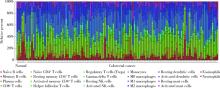
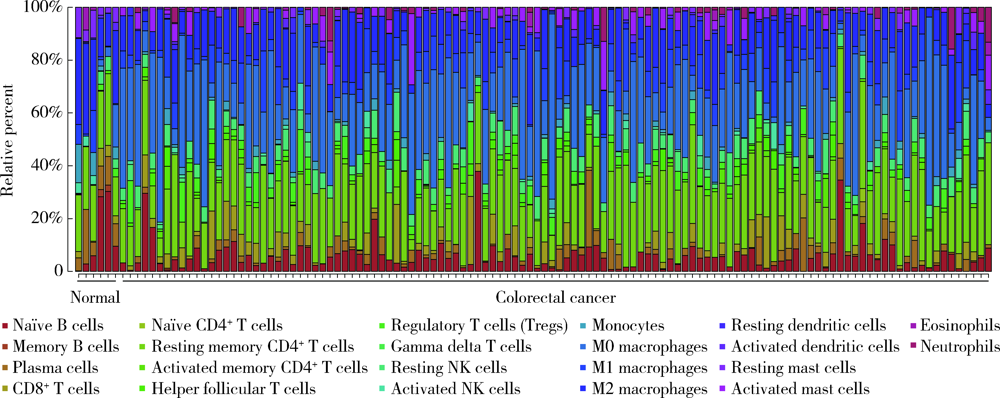
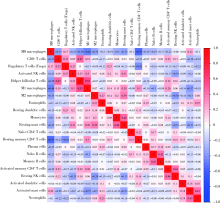
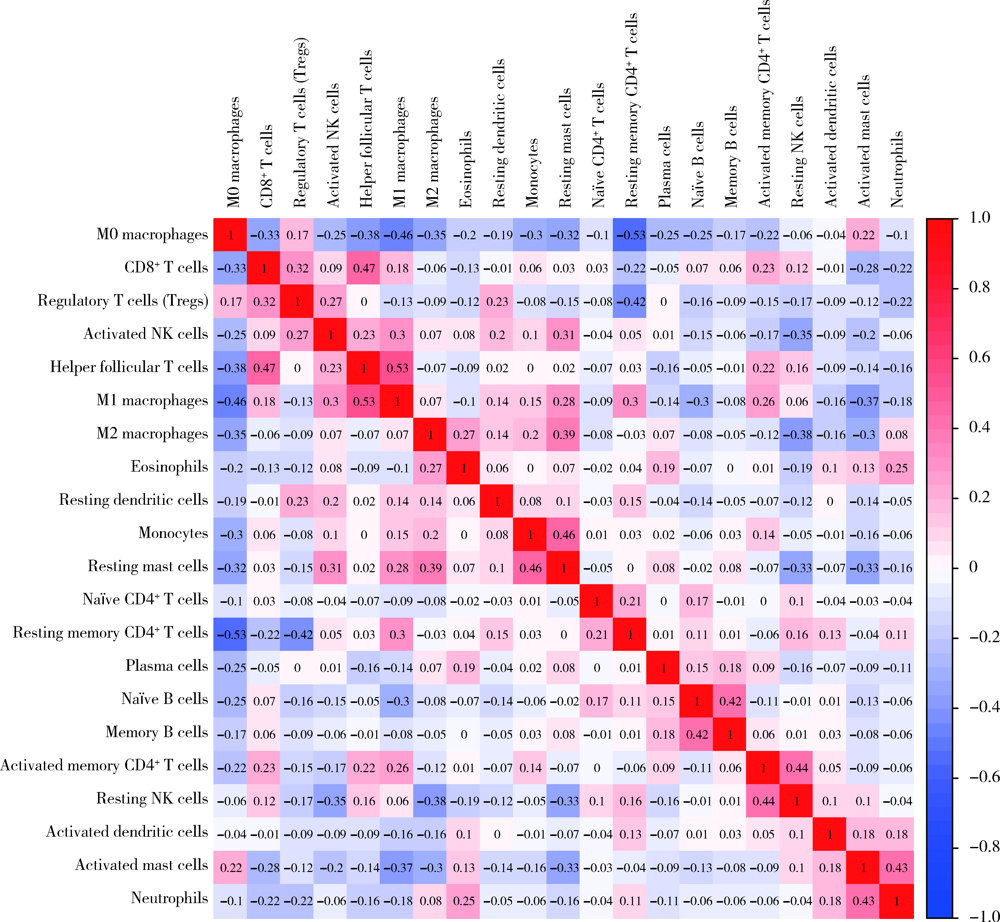
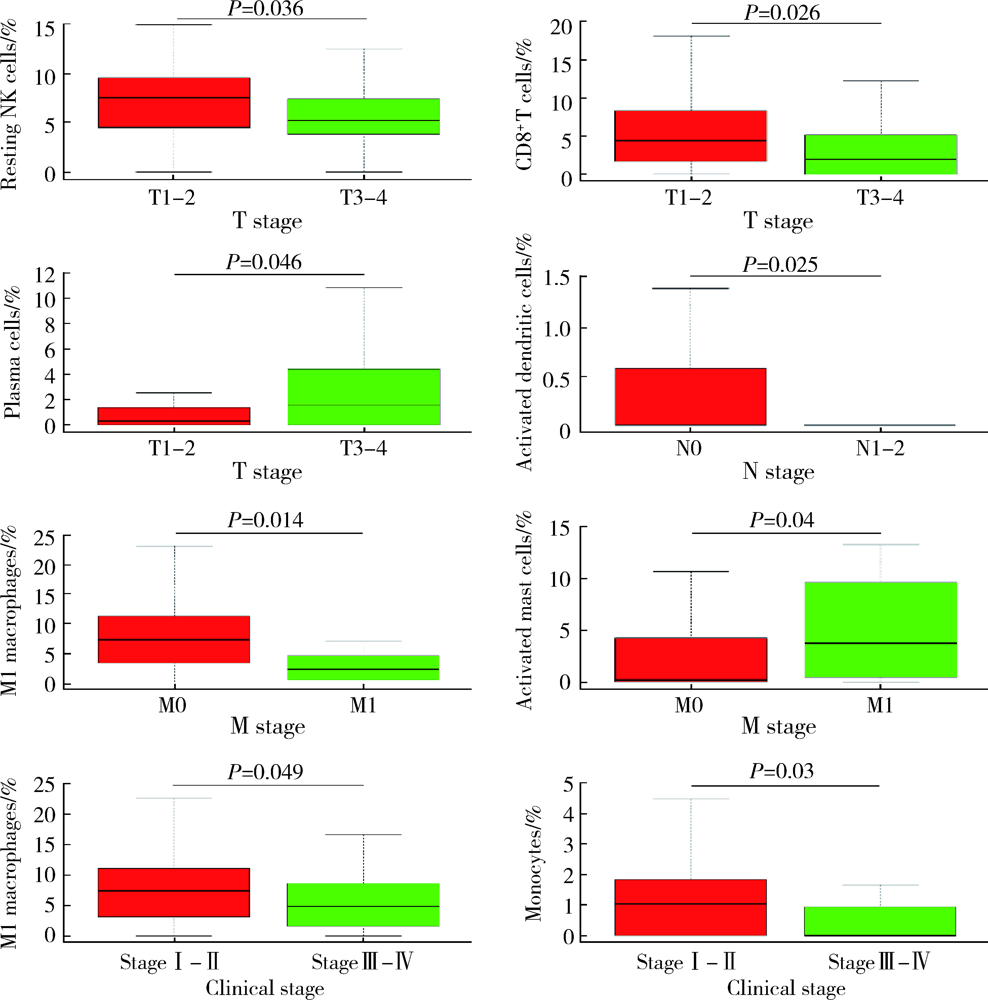
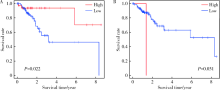
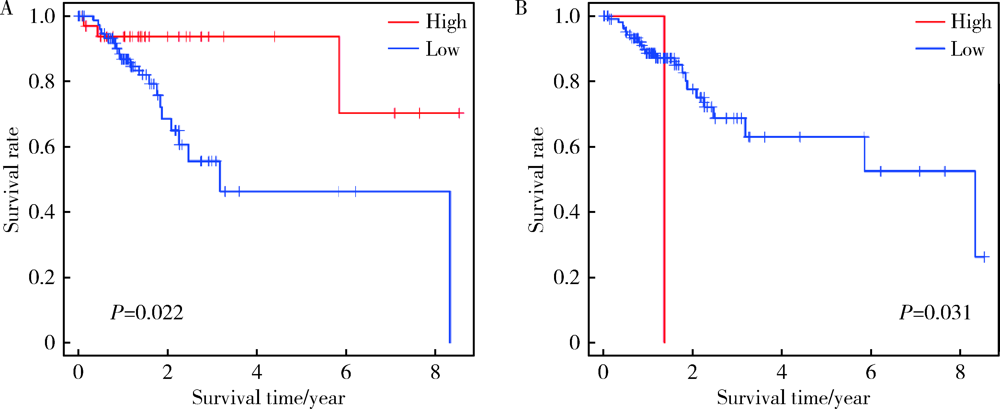
目的: 研究结直肠癌组织的免疫细胞浸润与临床预后之间的相关性。方法: 从癌症基因组图谱(the can-cer genome atlas,TCGA)中提取结直肠癌数据,基于反卷积算法(CIBERSORT)分析评估结直肠癌组织中22种肿瘤浸润性免疫细胞(tumor-infiltrating immune cells,TIICs)的浸润模式,以确定不同TIICs表达程度与5年生存率之间的关联。使用条形图展示结直肠癌样本中TIICs比例,绘制矩阵图分析不同TIICs之间的相关性。结果: 共从 TCGA数据库中提取了473例结直肠癌组织和41个正常对照组织,对比分析表明,结直肠癌组织中各种TIICs比例存在差异。在研究的细胞亚群中,结直肠癌组织中M0、M1和M2巨噬细胞和单核细胞的比例相对较高,而B细胞和中性粒细胞的比例相对较低。TIICs的比例与患者的TNM分期及临床分级显著相关:静息NK细胞、CD8+T细胞、浆细胞与T期相关,活化树突状细胞与N期相关,嗜酸性粒细胞、M1巨噬细胞及活化肥大细胞与M期相关,M1巨噬细胞和单核细胞与临床分级相关。生存分析结果显示,活化的树突状细胞与结直肠癌患者的5年生存率呈正相关,幼稚CD4+T细胞与5年生存率呈负相关。结论: 分析结直肠癌患者肿瘤组织TIICs亚群比例具有潜在的临床预后价值,可通过其识别可能从化疗中受益的患者,并预测新药的可能靶点。
中图分类号:
- R730.51
| [1] |
Siegel RL, Miller KD, Fedewa SA, et al. Colorectal cancer statistics, 2017[J]. CA Cancer J Clin, 2017, 67(3):177-193.
doi: 10.3322/caac.21395 |
| [2] | Shibutani M, Maeda K, Nagahara H, et al. Tumor-infiltrating lymphocytes predict the chemotherapeutic outcomes in patients with stage Ⅳ colorectal cancer[J]. In Vivo, 2018, 32(1):151-158. |
| [3] |
Guinney J, Dienstmann R, Wang X, et al. The consensus mole-cular subtypes of colorectal cancer[J]. Nat Med, 2015, 21(11):1350-1356.
doi: 10.1038/nm.3967 pmid: 26457759 |
| [4] |
Church J. Molecular genetics of colorectal cancer[J]. Sem Colon Rectal Surg, 2016, 27(4):172-175.
doi: 10.1053/j.scrs.2016.04.013 |
| [5] |
Bremnes RM, Al-Shibli K, Donnem T, et al. The role of tumor-infiltrating immune cells and chronic inflammation at the tumor site on cancer development, progression, and prognosis: Emphasis on non-small cell lung cancer[J]. J Thorac Oncol, 2011, 6(4):824-833.
doi: 10.1097/JTO.0b013e3182037b76 pmid: 21173711 |
| [6] |
Mao X, Xu J, Wang W, et al. Crosstalk between cancer-associated fibroblasts and immune cells in the tumor microenvironment: New findings and future perspectives[J]. Mol Cancer, 2021, 20(1):131-142.
doi: 10.1186/s12943-021-01428-1 |
| [7] |
Baxevanis CN, Papamichail M, Perez SA. Immune classification of colorectal cancer patients: Impressive but how complete?[J]. Expert Opin Biol Ther, 2013, 13(4):517-526.
doi: 10.1517/14712598.2013.751971 |
| [8] |
Grizzi F, Basso G, Borroni EM, et al. Evolving notions on immune response in colorectal cancer and their implications for biomarker developmentc[J]. Inflamm Res, 2018, 67(5):375-389.
doi: 10.1007/s00011-017-1128-1 pmid: 29322204 |
| [9] |
Newman AM, Liu CL, Green MR, et al. Robust enumeration of cell subsets from tissue expression profiles[J]. Nat Methods, 2015, 12(5):453-457.
doi: 10.1038/nmeth.3337 pmid: 25822800 |
| [10] |
Liu X, Wu S, Yang Y, et al. The prognostic landscape of tumor-infiltrating immune cell and immunomodulators in lung cancer[J]. Biomed Pharmacother, 2017, 95:55-61.
doi: 10.1016/j.biopha.2017.08.003 |
| [11] |
Quail DF, Joyce JA. Microenvironmental regulation of tumor progression and metastasis[J]. Nat Med, 2013, 19(11):1423-1437.
doi: 10.1038/nm.3394 |
| [12] |
Klemm F, Joyce JA. Microenvironmental regulation of therapeutic response in cancer[J]. Trends Cell Biol, 2015, 25(4):198-213.
doi: 10.1016/j.tcb.2014.11.006 |
| [13] |
Anitei MG, Zeitoun G, Mlecnik B, et al. Prognostic and predictive values of the immunoscore in patients with rectal cancer[J]. Clin Cancer Res, 2014, 20(7):1891-1899.
doi: 10.1158/1078-0432.CCR-13-2830 |
| [14] |
Huh JW, Lee JH, Kim HR. Prognostic significance of tumorinfiltrating lymphocytes for patients with colorectal cancer[J]. Arch Surg, 2012, 147(4):366-372.
doi: 10.1001/archsurg.2012.35 |
| [15] |
Karpinski P, Rossowska J, Sasiadek MM. Immunological landscape of consensus clusters in colorectal cancer[J]. Oncotarget, 2017, 8(62):105299-105311.
doi: 10.18632/oncotarget.v8i62 |
| [16] |
Mirjolet C, Charon-Barra C, Ladoire S, et al. Tumor lymphocyte immune response to preoperative radiotherapy in locally advanced rectal cancer: The LYMPHOREC study[J]. Oncoimmunology, 2018, 7(3):e1396402.
doi: 10.1080/2162402X.2017.1396402 |
| [17] |
Galon J, Costes A, Sanchez-Cabo F, et al. Type, density, and location of immune cells within human colorectal tumors predict clinical outcome[J]. Science, 2006, 313(5759):1960-1964.
doi: 10.1126/science.1129139 |
| [18] |
Klintrup K, Makinen JM, Kauppila S, et al. Inflammation and prognosis in colorectal cancer[J]. Eur J Cancer, 2005, 41(17):2645-2654.
doi: 10.1016/j.ejca.2005.07.017 pmid: 16239109 |
| [19] |
Li T, Fan J, Wang B, et al. TIMER: A web server for comprehensive analysis of tumor-infiltrating immune cells[J]. Cancer Res, 2017, 77(21):e108-e110.
doi: 10.1158/0008-5472.CAN-17-0307 |
| [20] |
Pagès F, Mlecnik B, Marliot F, et al. International validation of the consensus immunoscore for the classification of colon cancer: A prognostic and accuracy study[J]. Lancet, 2018, 391(10135):2128-2139.
doi: 10.1016/S0140-6736(18)30789-X |
| [21] |
Steinman RM. Decisions about dendritic cells: Past, present, and future[J/OL]. Annu Rev Immunol, 2012, 30:1-22. doi: 10.1146/annurevimmunol-100311-102839.
doi: 10.1146/annurevimmunol-100311-102839 |
| [22] |
Shimizu K, Kotera Y, Aruga A, et al. Postoperative dendritic cell vaccine plus activated T-cell transfer improves the survival of patients with invasive hepatocellular carcinoma[J]. Hum Vaccin Immunother, 2014, 10(4):970-976.
doi: 10.4161/hv.27678 |
| [23] | Pagès F, Kirilovsky A, Mlecnik B, et al. In situ cytotoxic and memory T cells predict outcome in patients with early-stage colorectal cancer[J]. J Clin Oncol, 2009, 27(35):5944-5951. |
| [24] |
Gannon PO, Baumgaertner P, Huber A, et al. Rapid and continued T-cell differentiation into long-term effector and memory stem cells in vaccinated melanoma patients[J]. Clin Cancer Res, 2017, 23(13):3285-3296.
doi: 10.1158/1078-0432.CCR-16-1708 |
| [1] | 赵豆豆, 齐晅, 黄博, 高伟波, 裴源源, 金月波, 邵苗, 何菁. 感染性肺炎与免疫相关间质性肺病中淋巴细胞亚群的表达[J]. 北京大学学报(医学版), 2026, 58(3): 624-630. |
| [2] | 王楠楠, 袁大晋, 朱昱冰, 丁磊. 结直肠癌根治术后肝转移风险多中心列线图预测模型的构建与验证[J]. 北京大学学报(医学版), 2026, 58(2): 290-300. |
| [3] | 林文灏, 谢阳, 王芳晴, 王淑盈, 刘香君, 胡凡磊, 贾园. 基于B细胞单细胞转录组测序的干燥综合征分子分型[J]. 北京大学学报(医学版), 2025, 57(6): 1032-1041. |
| [4] | 刘艳华, 陆敏, 赵旭阳, 张宽根, 武睿, 梅放, 戴志豪, 由江峰, 裴斐. 肿瘤转移抑制基因LASS2去磷酸化对液泡型ATP酶活性及前列腺癌侵袭性的影响[J]. 北京大学学报(医学版), 2025, 57(6): 1113-1123. |
| [5] | 李博闻, 张强, 孙益鑫. 儿童及青年漏斗胸患者Nuss术后发生脊柱侧弯的风险预测模型建立及验证[J]. 北京大学学报(医学版), 2025, 57(5): 941-946. |
| [6] | 杨小勇, 张帆, 马潞林, 刘承. 前列腺导管腺癌临床特征及腺外侵犯的影响因素[J]. 北京大学学报(医学版), 2025, 57(5): 956-960. |
| [7] | 秦秋实, 李蕊, 周妍希, 张玥, 韩铭, 朱鏐娈. 敲减Blimp1基因表达对CCl4诱导的小鼠肝纤维化模型早期肝损伤的保护作用[J]. 北京大学学报(医学版), 2025, 57(4): 727-734. |
| [8] | 韩丹, 次仁央金, 李秋红, 李军. 高海拔地区结直肠良恶性肿瘤患者肠道菌群差异及其与低海拔地区正常人群的比较[J]. 北京大学学报(医学版), 2025, 57(3): 578-583. |
| [9] | 罗丹, 黄海建, 陈新, 陈小岩. 原发子宫肝样腺癌2例临床病理分析及文献复习[J]. 北京大学学报(医学版), 2024, 56(6): 1126-1131. |
| [10] | 赵亮, 史成龙, 马柯, 赵静, 王潇, 邢晓燕, 莫万星, 练益瑞, 高超, 李玉慧. 抗合成酶综合征重叠类风湿关节炎患者的免疫学特征[J]. 北京大学学报(医学版), 2024, 56(6): 972-979. |
| [11] | 刘园梅, 傅义程, 郝靖欣, 张福春, 刘慧琳. 老年髋部骨折患者住院期间发生术后心力衰竭的列线图预测模型的构建及验证[J]. 北京大学学报(医学版), 2024, 56(5): 874-883. |
| [12] | 李志存, 吴天俣, 梁磊, 范宇, 孟一森, 张骞. 穿刺活检单针阳性前列腺癌术后病理升级的危险因素分析及列线图模型构建[J]. 北京大学学报(医学版), 2024, 56(5): 896-901. |
| [13] | 欧俊永,倪坤明,马潞林,王国良,颜野,杨斌,李庚午,宋昊东,陆敏,叶剑飞,张树栋. 肌层浸润性膀胱癌合并中高危前列腺癌患者的预后因素[J]. 北京大学学报(医学版), 2024, 56(4): 582-588. |
| [14] | 刘帅,刘磊,刘茁,张帆,马潞林,田晓军,侯小飞,王国良,赵磊,张树栋. 伴静脉癌栓的肾上腺皮质癌的临床治疗及预后[J]. 北京大学学报(医学版), 2024, 56(4): 624-630. |
| [15] | 周泽臻,邓绍晖,颜野,张帆,郝一昌,葛力源,张洪宪,王国良,张树栋. 非转移性T3a肾细胞癌患者3年肿瘤特异性生存期预测[J]. 北京大学学报(医学版), 2024, 56(4): 673-679. |
|
||
